

AhlulBayt News Agency: The programme, titled Allama Muhammad Husain Tabatabai (RA) and New Dimensions in Understanding the Quran, featured detailed discussions on the distinctive features of Tafsir al-Mizan, the methodology of Tafsir al-Quran bil-Quran (interpreting the Quran through the Quran), and the harmony between reason and revelation. Speakers observed that Tafsir al-Mizan represents an important scholarly legacy of the Hawza Ilmiyya of Qom, offering a new perspective on understanding the Quran and exploring the deeper meanings of its verses.
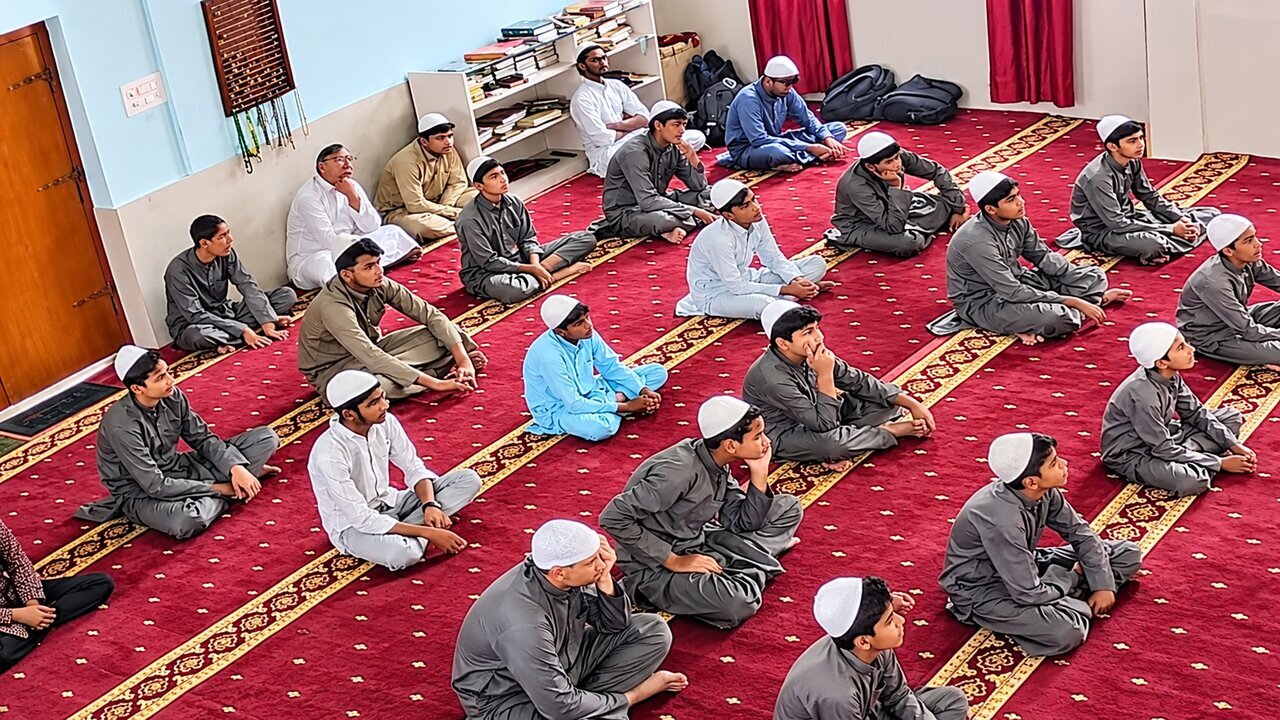
The session began with the recitation of the Holy Quran. Subsequently, Hujjat-ul-Islam wal-Muslimeen Dr Mirza Muhammad Rafiei, assistant academic in-charge of the seminary, explained the objectives and academic significance of the gathering. He said that such sessions aim to enhance students' scholarly abilities, encourage research and develop a deeper understanding of Quranic teachings.
Hujjat-ul-Islam wal-Muslimeen Maulana Mir Athar Ali, director of Hawzat-e-Ilmiyya Alipur, welcomed the guests and highlighted Allama Tabatabai's scholarly standing and contributions to Quranic studies. He said that many of the academic and research activities currently being conducted in Quranic sciences and exegesis at the Hawza Ilmiyya of Qom and Al-Mustafa International University are deeply connected to Allama Tabatabai's intellectual legacy, particularly his renowned work Tafsir al-Mizan.
The programme was conducted by the director of Madrasa Baqir-ul-Uloom, Alipur.
Methodology of Tafsir al-Mizan and Tafsir al-Quran bil-Quran
Maulana Syed Azhar Husain discussed one of the principal features of Tafsir al-Mizan, namely Tafsir al-Quran bil-Quran. He explained that this methodology involves understanding and clarifying one Quranic verse in the light of another.
He said that Allama Tabatabai did not restrict the interpretation of Quranic words to linguistic explanations or narrations alone. Instead, he also examined the connections between different verses and explained their deeper meanings. As an example, he noted that the word *“Yad”* (hand) is used in certain Quranic contexts to signify power and authority rather than a physical hand.
He also highlighted Allama Tabatabai's other scholarly contributions, particularly his renowned philosophical work *Bidayat al-Hikmah*, and mentioned some of his distinguished students, including Shaheed Murtaza Mutahhari (RA). He encouraged students to study Tafsir al-Mizan and benefit from this valuable intellectual legacy.
Maintaining a Continuous Connection with the Quran Is Essential: Maulana Syed Manzoor Raza Abidi
Maulana Syed Manzoor Raza Abidi, the Friday prayer leader of Alipur, highlighted the importance of supplication, seeking forgiveness and praying for divine mercy on the occasion of Thursday night.
He said that the purpose of such academic gatherings is not merely to remember great scholars but also to benefit practically from their contributions, teachings and intellectual perspectives.
Speaking about the greatness of the Quran, he described it as a living Book. He said that a person who connects their life with the Quran ensures that their name and scholarly contributions also remain alive through it. Allama Tabatabai's life, he added, is a clear example of this principle. Although the scholar is no longer physically among us, his Quranic services and intellectual legacy have ensured that his name remains alive for generations.
Maulana Manzoor Raza Abidi observed that Allah has bestowed every individual with certain abilities, but talent alone is not sufficient to achieve success. Continuous hard work, perseverance and dedication are necessary to develop one's potential. Through his extraordinary efforts and tireless dedication, Allama Tabatabai rendered an outstanding service to Quranic exegesis.
Highlighting two major characteristics of Tafsir al-Mizan, he identified the first as Tafsir al-Quran bil-Quran, in which one verse is explained through another. Referring to the subject of intercession (Shafa'at), he explained that the Quran does not reject intercession altogether; rather, it rejects intercession that takes place without Allah's permission.
He identified the second major characteristic as the harmony between reason and revelation. According to him, Allama Tabatabai demonstrated that reason and divine revelation are not contradictory, as both originate from Allah. The Quran itself repeatedly encourages human beings to think, reflect and exercise understanding.
Maulana Abidi also stressed the importance of regularly organising such academic gatherings for scholars and students. He said these programmes serve as important platforms for intellectual development as well as academic and spiritual training.
Allama Tabatabai's Scholarly Life and Methodology of Quranic Exegesis
Maulana Syed Dalevar Husain spoke about Allama Syed Muhammad Husain Tabatabai's (RA) life, scholarly journey and research contributions.
He explained that Allama Tabatabai was born in 1903 in the village of Shadabad, near the Iranian city of Tabriz. Despite losing both his parents during childhood, he continued his pursuit of education and knowledge.
He received religious education in Najaf Ashraf under several distinguished scholars of his time. Later, after returning to Tabriz, he spent approximately ten years supporting himself through agricultural activities while continuing his intellectual and Quranic studies. He subsequently moved to Qom, where he began teaching and conducting research and established a distinguished position through his scholarship.
Explaining the different stages of understanding the Quran, Maulana Dalevar Husain said that after recitation (Tilawat), proper pronunciation (Tajweed) and translation, studying Tafsir is an essential means of reaching the deeper meanings and messages of the Quran. Through Tafsir, readers become acquainted with the profound meanings, guidance and practical instructions contained in its verses.
Highlighting the academic significance of Tafsir al-Mizan, he said that numerous later Quranic exegetes had benefited from this work, and references to it could be found in various other commentaries. He described this as clear evidence of Allama Tabatabai's dedication and exceptional research standards.
Maulana Dalevar Husain also explained two major approaches to Quranic exegesis: Tafsir-e-Tartibi and Tafsir-e-Mawzui.
He said that Tafsir-e-Tartibi involves the sequential interpretation of Quranic verses, beginning with Surah al-Fatiha and continuing through Surah al-Nas. In contrast, Tafsir-e-Mawzui is a thematic approach in which all Quranic verses relating to a particular subject, such as morality, backbiting, slander or other issues, are collected and studied together.
He also discussed other methods of Quranic interpretation, particularly traditional, philosophical, mystical, social and theological approaches.
Citing Tafsir Qummi, Nur al-Thaqalayn, Tafsir al-Safi and Al-Burhan as examples of traditional narrational commentaries, he highlighted the importance of Tafsir Namuna as a useful resource for general readers.
Maulana Dalevar Husain explained that one of the major strengths of Tafsir al-Mizan is its use of different scholarly approaches to Quranic interpretation. Where narrations are required, it draws upon narrations; where philosophical discussions are necessary, it employs philosophical reasoning; and where mystical or linguistic explanations are relevant, it draws upon those respective fields of knowledge.
However, he emphasised that its most distinctive feature remains Tafsir al-Quran bil-Quran, the interpretation of one Quranic verse through another.
Speakers Emphasise the Importance of Benefiting from Scholarly Heritage and Understanding the Quran
The discussions highlighted that Allama Syed Muhammad Husain Tabatabai (RA) was not only a distinguished Quranic exegete but also an eminent philosopher, researcher, teacher and Islamic thinker. Through his dedication, scholarship and profound Quranic insight, he left an invaluable intellectual legacy for the Islamic world.
The central message of Tafsir al-Mizan, speakers observed, is that the Quran should not be regarded merely as a Book for recitation but as a comprehensive guide to life, offering divine guidance and encouraging reflection, contemplation and practical action.
They said that genuinely benefiting from Allama Tabatabai's intellectual legacy requires studying his Quranic contributions, particularly Tafsir al-Mizan, and incorporating his Quranic insights into individual and collective life.
At the conclusion of the programme, assistant academic in-charge Dr Maulana Muhammad Rafiei thanked all the scholars, speakers and students for their participation.
He particularly acknowledged the contributions and presence of Hujjat-ul-Islam Maulana Syed Dalevar Husain, Alipur's Friday prayer leader Hujjat-ul-Islam Maulana Syed Manzoor Raza Abidi, Maulana Syed Shabbir Ali, Maulana Tashakkur, Maulana Muhammad Yusha, Maulana Mujassim, Hujjat-ul-Islam Maulana Syed Nazar Abbas and Dr Maulana Azadar Husain.
Students were also encouraged and appreciated for their participation. The final segment featured a question-and-answer session in which students raised academic questions and benefited from the responses of the speakers. Attractive prizes were subsequently distributed among students who had participated in academic activities.
The programme concluded with a renewed commitment to drawing inspiration from Allama Muhammad Husain Tabatabai's (RA) Quranic, exegetical and intellectual contributions, encouraging academic exchanges between scholars and students, and promoting a deeper understanding of the Holy Quran.



Your Comment